For most people searching this topic, the main question in mind is simple, how one on one training actually works for a young dog, and why sometimes it works out better than the group classes. Put in simple words, private puppy training is when trainer gives attention to only your puppy, keeping focus on its own personality, its own speed of learning, and whatever specific problem it has, rather than sticking to one fixed group course made for everyone. Because the focus stays this personal, many owners notice that progress comes faster with private sessions, plus the advice given actually suits their own home and daily routine better.
Why Early Training Matters So Much for Puppies
During the first months of a puppy’s life, there comes a stage where its brain stays very much open for learning new things. In this period, habits get formed quite fast, no matter if they are good ones or bad ones. When proper guidance is missing in this window, small problems such as jumping over guests, pulling hard on the leash, or barking too much, these can slowly turn into habits that later become much harder to correct. Training at early stage is not only about teaching obedience, it also gives puppy more confidence and less anxiousness whenever new situations or new people come around.
Private Sessions vs Group Classes: What’s the Real Difference?
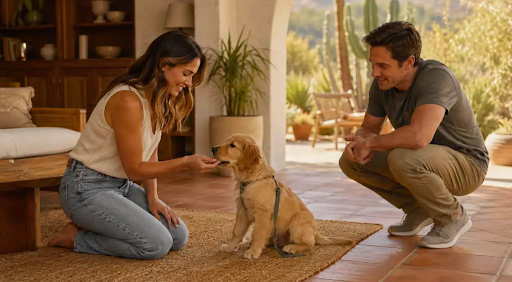
Group classes do carry their own benefit too, mainly for socialising purpose, since puppies get chance to meet others inside a safe environment. But it’s not like every puppy manages well in such setting. Puppies who feel shy, get distracted easily, or show some reactive behaviour, they often find it difficult inside a group. With private training, this kind of pressure gets removed completely. Trainer is able to give whole attention to just single puppy, and many times the session happens right inside puppy’s own home, which makes the learned behaviour blend into daily life in much more natural way.
What Usually Gets Covered in a Private Training Session?
Mostly, training programs are built around few core skills which support the good behaviour for long run:
- Basic commands, such as sit, stay, come and down
- Walking with leash without constant pulling
- Crate training along with manners inside house
- Building control over impulse near food, toys and people
- Becoming comfortable with handling and grooming
- Practicing calm behaviour whenever guest arrives
Once puppy becomes confident enough with these basic points, trainers then usually shift towards little more advanced skill.
How Much Time Does It Take Before Results Show?
This mostly depends on puppy itself, its breed type, and how much consistent the family stays with practice between the sessions. In many case, some visible change in commands and self control can be seen within few weeks itself. But for training to become fully reliable one, it usually takes couple of months with steady practice. Puppy training, in truth, is never something that finishes in single event, it works more like ongoing process which asks for repetition, both during session time and in normal daily life too.
Does Private Training Actually Help With Behaviour Issues?
Yes, in many case it does help. Since whole focus remains on single dog only, private training tends to give good result for issues like separation anxiety, guarding around food or toys, reactions coming from fear, or too much mouthing habit. Trainer who works closely with only one puppy, this person can notice small pattern very easily, and can change method right at that moment if required, something which becomes quite hard inside group setting where multiple dogs need attention altogether.
Is This Type of Training Right for Every Breed?
Not every breed learns in same manner, so training often needs some adjustment. Breeds with high energy or working type mostly need extra mental challenge added inside their session, while smaller companion breed might need more attention towards building confidence and comfort near people. Since private training carries flexible nature by itself, whole approach can get shaped depending on temperament, energy level, or even any physical limitation puppy might carry, something which standard group class usually fails to give.
Why Consistency Makes Such a Big Difference
Out of all factor, consistency probably stands as most important one for getting success. Puppies learn through action getting repeated and response staying predictable for whatever they do. When same command, same routine and same expectation get followed session after session, learning happens quicker and it also stays longer in memory. This is exact reason why good training advice mostly goes beyond just session time, giving owner clear step so lesson keeps getting reinforced once puppy is back home.
What Should a Good Training Plan Actually Include?
Solid training plan should carry clear goal, timeline that stays realistic, and some method to track the progress along way. Just as much important, it should give proper guidance towards owner too, since big part of puppy’s learning actually takes place outside the formal training time. Knowing correct way to reinforce command, catching early sign of stress, and managing everyday trigger, all this matters equally as much as the session itself.
To sum up everything, private puppy training gives focused and flexible way for building good habit at early stage, dealing with specific behaviour challenge, and helping puppy move smoothly towards its adulthood. Since every single session gets shaped around what that particular puppy needs, this method often brings steadier progress along with stronger base for good behaviour and confidence throughout dog’s whole life.